
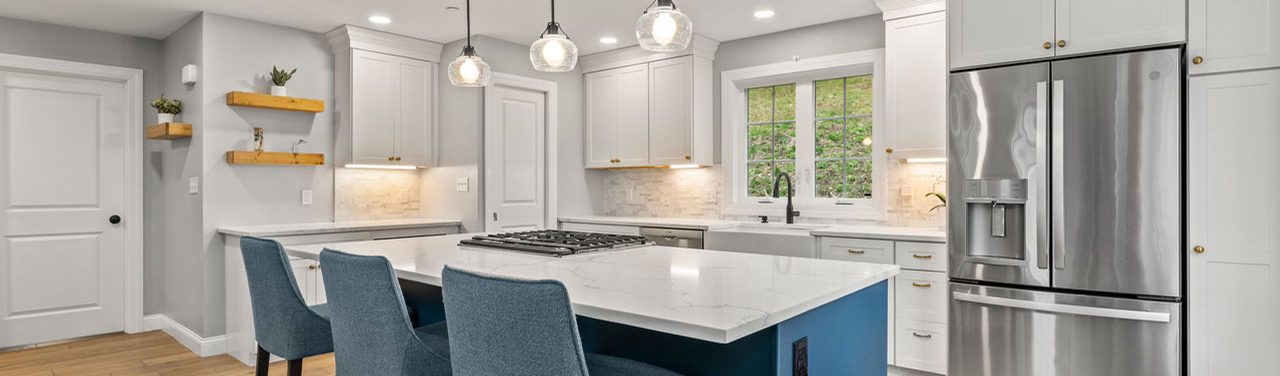
People usually frame this as a money question, and it is, but not the one they think. The comparison is not "kitchen versus new house". It is the cost of the kitchen against the transaction cost of moving, which is the part that gets overlooked.
What a kitchen actually costs here
| Scope | Relative cost | What moves it |
|---|---|---|
| Functional update: same layout, new finishes | Least expensive | Nothing structural moves and the services stay where they are |
| Mid-range: semi-custom cabinetry, stone tops | Middle | Cabinetry and countertop specification does most of the work |
| Full gut with layout changes and custom cabinetry | Most expensive | Moving plumbing and electrical, plus custom cabinetry lead times |
Massachusetts sits above national averages, driven by licensed trade rates and by a strict building code. National cost calculators consistently understate what a kitchen here costs.
What moving actually costs
This is where the comparison usually turns. Moving is not the price difference between two houses. It is:
- Broker commission on the sale, which is more negotiable than it used to be.
- Massachusetts deeds excise tax on the sale.
- Closing costs and lender fees on the purchase.
- The move itself, plus the inevitable work on the new house.
- A new mortgage at current rates, which for anyone holding a sub-4% loan is the largest hidden cost of all.
Put together, the transaction costs on a sale and a comparable purchase commonly run to the price of a mid-range kitchen before anyone has changed a light fixture. That is real money spent on nothing but the act of moving.
The mortgage point deserves emphasis. If you are holding a mortgage from 2020 or 2021, giving it up to buy at current rates can cost more per month than financing the entire renovation. Run that number before anything else, because for a lot of households it ends the discussion.
What you get back
Kitchens return better than almost any other remodel, and smaller ones return best. Using New England figures from the Cost vs Value report:
| Project | Share of cost recovered at resale |
|---|---|
| Minor kitchen remodel / refresh | Highest of the three |
| Mid-range kitchen remodel | Middle |
| Major or upscale remodel | Lowest |
The pattern is consistent and worth internalizing: the more you spend, the smaller the share you get back. Nobody recovers all of it, and what does not show up in the resale figure is the years you actually use the kitchen, which is the part a spreadsheet cannot capture and the main reason to do it at all.
When remodeling is the right call
- You like the house, the street and the schools, and the kitchen is the problem.
- You are holding a low-rate mortgage.
- The layout can work: the space exists, it is just badly arranged.
- You are staying five years or more, long enough to enjoy it rather than buying it for a buyer.
When moving is the right call
- The house is wrong in ways a kitchen cannot fix: too few bedrooms, no yard, wrong town, hopeless commute.
- You would need to spend past the ceiling for your street. Every neighborhood has a price no amount of finish exceeds, and a top-of-the-market kitchen in a modest house does not come back.
- The house needs a kitchen and a roof and windows and a heating system. At that point you are renovating a whole house, and buying one already done is often cheaper.
- You want to be somewhere else. This is a perfectly good reason and does not need a financial justification.
The third option people forget
Very often the kitchen is not too dated: it is too small, or in the wrong place. In that case neither remodeling within the existing footprint nor moving is the right answer. A home addition that opens the back of the house and rebuilds the kitchen into it solves a problem that new cabinets in the same room cannot touch.
It costs more than a kitchen and far less than moving, and it is the option we end up recommending more than any other when someone opens with "should we just move".
How to decide in one afternoon
Get three numbers: a realistic remodel figure for the scope you want, your true all-in cost of moving including the mortgage change, and an honest view of what your street will support at resale. Those three settle most of these decisions without much agonizing.
We are happy to give you the first one, whether or not the answer ends up being a renovation. More on our approach on the kitchen remodeling page. We work throughout Newburyport, Merrimac and Groveland.
A worked example
A family in the Merrimack Valley with a dated but workable kitchen, holding a mortgage from the low-rate years. They want a mid-range remodel. The alternative is trading up to a more expensive house with the kitchen already done.
| Remodel | Move | |
|---|---|---|
| Direct cost | The remodel | The price difference between the two houses |
| Transaction costs | None | Commission, excise and closing on both sides |
| Mortgage | Unchanged | A new loan at current rates |
| Recovered at resale | Most of the remodel, not all | Not applicable |
| Disruption | 6 to 12 weeks without a kitchen | A house move |
Before the monthly payment is even considered, moving costs substantially more than the remodel. Then add the mortgage: giving up a low-rate loan on a substantial balance to borrow more at current rates is frequently a larger monthly increase than financing the whole renovation would be.
This is why so many households who begin at "we need a bigger kitchen, maybe we should move" end up renovating. It is not sentiment; it is arithmetic, and the rate environment has made the arithmetic much more one-sided than it was five years ago.
Is it the finishes, or is it the layout?
Worth separating, because the two have very different price tags. Signs it is the finishes: everything is where you want it, you just dislike how it looks. That is the cheapest kind of kitchen project and sits at the lower end of the range.
Signs it is the layout:
- Two people cannot work in it at once without a negotiation.
- The fridge, sink and range are arranged so you cross the room constantly.
- There is nowhere to put shopping down when you come in.
- The room is closed off from where everyone else in the house actually is.
- You eat in a separate room because the kitchen has no space to sit.
Those are structural complaints, and new cabinets in the same positions will not fix any of them. This is the case where taking out a wall, or extending the back of the house, produces a result that a same-footprint remodel simply cannot.
What the work actually involves
A realistic picture of the disruption, because it affects the decision:
| Stage | Duration | What it means at home |
|---|---|---|
| Design and ordering | 4 to 8 weeks | No disruption; cabinetry lead time drives this |
| Demolition | 2 to 4 days | Noise, dust, kitchen gone |
| Rough electrical and plumbing | 1 to 2 weeks | Inspections; no kitchen |
| Cabinets and countertop template | 1 to 2 weeks | Countertop is templated after cabinets, then fabricated |
| Countertop, tiling, fixtures | 2 to 3 weeks | Kitchen becoming usable at the end |
| Finish and punch list | 1 week | Effectively back to normal |
The countertop is the item people do not anticipate. Stone is templated after the cabinets are set and then fabricated off site, which is a real gap in the middle of the project with cabinets in and no surface on them. Planning a temporary kitchen around that gap makes the whole thing far more bearable.
If you are moving anyway
Do not do a full remodel to sell. You do not get all of it back on a mid-range project, and buyers rarely value your specific choices at what you paid for them. A minor refresh recovers a far larger share of its cost and is the better pre-sale move: paint, hardware, countertop, lighting, and fixing anything visibly broken.
Spend the money on a kitchen you will use for a decade, or spend a fraction of it on presentation. The expensive middle path, a major remodel you enjoy for eight months before listing, is the one to avoid.
Frequently asked questions
How long does a kitchen remodel take?
Six to twelve weeks on site for most projects, plus four to eight weeks of design and ordering beforehand. Cabinetry lead times drive the schedule more than the building work does, so ordering early matters more than starting early. Layout changes that move plumbing or take out a wall add both time and inspections.
Will I get my money back on a kitchen remodel?
Partly, and the smaller the project the better the ratio. A minor refresh recovers the largest share of its cost, a mid-range remodel less, and a major or upscale remodel least of all. Nobody recovers all of it, so the years of use have to be worth something to you for the decision to make sense.
Can I stay in the house during a kitchen remodel?
Most people do, and it is harder than they expect. You are without a kitchen for the bulk of it. A temporary set-up in the dining room with a microwave, kettle and the fridge relocated makes a real difference, and we plan that with you rather than leaving it to be discovered on day one.