
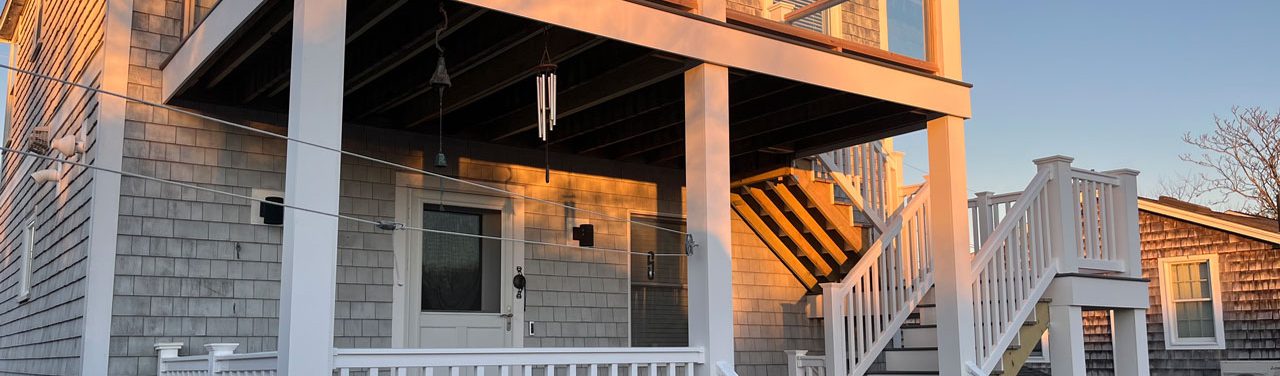
A deck is not really priced by area, which is why the per-square-foot figures published online vary so widely that they stop being useful. Two decks of identical size on the same street can differ substantially once you account for what holds them up and how the crew reaches the site.
Those ranges are wide because a deck is not really priced by area. It is priced by height, ground conditions, railing, and how much structure sits underneath.
Cost by material
| Material | Relative up-front cost | Ongoing upkeep | Expected lifespan |
|---|---|---|---|
| Pressure-treated pine | Lower | Cleaning, sanding and sealing on a regular cycle | 10 to 15 years, 15 to 20 with diligent care |
| Composite (Trex, TimberTech) | Higher | Washing only | 25 to 30 years |
Composite costs more up front and less to keep. Wood is cheaper to build and carries a sealing, sanding and board-replacement cycle for as long as you own it. Which one is cheaper over your ownership depends almost entirely on how long that is, and on whether you will genuinely do the maintenance.
What actually drives the number
Height above grade
This is the biggest single factor and it is invisible in a square-footage quote. A deck twenty inches off the ground needs short posts and no guard rail. The same deck off the back of a raised ranch, eight feet up, needs deeper footings, longer posts, lateral bracing, a guard rail to code, and stairs. Same area, materially different build.
Railing
Railing is frequently a fifth of the total and it is where finish choices bite hardest. Pressure-treated railing is inexpensive. Composite railing with aluminum balusters costs several times more per linear foot, and cable rail more again.
Footings and what is under the lawn
Massachusetts footings go below the frost line, which means real excavation. Ledge is common across the Merrimack Valley and turns a straightforward footing into a day with different equipment. Nobody can price this precisely before breaking ground, which is why a contractor who gives you a confident number without having looked at the site is guessing.
Stairs
Stairs are expensive per square foot of deck they serve. A straight run to grade is fine; a turn, a landing, or a long run from a raised deck adds up quickly.
Permits, and why we pull them
Decks above a certain height need a building permit in every Merrimack Valley town, and the inspection matters: ledger attachment to the house is the most common point of failure in deck collapses, and it is exactly what an inspector looks at.
We file permits on our own Home Improvement Contractor registration rather than asking you to. Under M.G.L. c.142A, a homeowner who pulls their own building permit is excluded from the Guaranty Fund, the state program that can pay out against an unpaid judgment against a registered contractor. A contractor who asks you to take the permit out in your own name is asking you to carry a risk that should be theirs.
Local considerations
Lot size and setbacks differ a great deal between the three towns we work in most, and they decide what a deck can be before the design does. In Newburyport’s South End, small lots and close neighbours mean the constraint is often the setback rather than the budget. In Groveland, post-war subdivisions on generous lots give far more freedom. Properties near the Merrimack frontage or a mapped wetland in Merrimac can need a Conservation Commission filing, which adds weeks before anything is built.
How to compare quotes properly
- Ask what the footing spec is, and whether the price holds if ledge is hit.
- Ask what the railing is, specifically. It is a large share of the difference between two quotes.
- Ask whether stairs, landings and any lattice or skirt are included or extra.
- Ask who pulls the permit. If the answer is "you do", ask why.
- Ask for the HIC registration number and check it on the state register.
Two quotes that look far apart are usually describing two different decks. More on how we build them on our deck building page, and the material question is covered in depth in composite vs wood decking in New England.
Attached or freestanding?
A deck attached to the house carries its inboard load on a ledger board bolted to the rim joist. Done correctly, with proper fasteners and flashing, that is entirely sound. Done badly it is the single most common cause of deck collapse, which is why it is the first thing an inspector looks at.
A freestanding deck carries its own load on an additional beam and post line. It costs a little more in materials and avoids penetrating the building envelope at all. On older houses where the rim joist is of uncertain condition, which describes a good deal of the housing stock in this area, freestanding is sometimes the better engineering answer rather than merely the more cautious one.
Design choices that cost more than people expect
| Choice | Effect on cost | Worth it when |
|---|---|---|
| Picture-frame border | Adds material and labor | The deck is highly visible from the house |
| Diagonal decking | More cuts, more waste, closer joists | You want the look and have the budget |
| Hidden fasteners | Slower to install | Composite, and you want a clean surface |
| Multi-level | A second structure in effect | Grade changes make one level awkward |
| Built-in seating or planters | Custom carpentry | You genuinely will use it |
| Under-deck storage or skirting | Framing plus finish | The deck is high enough to be worth enclosing |
None of these are wrong. They are simply the items that separate a modest deck from an expensive one at the same square footage, and they are worth deciding on deliberately rather than discovering in a quote.
The twenty-year cost, not the day-one cost
A pressure-treated deck is cheaper to build and more expensive to own. Annual cleaning and sealing has a real cost whether you pay someone or spend the weekend yourself, and board replacement typically starts somewhere around year eight to ten.
Composite reverses that: more up front, very little after. The crossover is usually quoted at eight to twelve years. The practical way to decide is to ask how long you expect to own the house and whether you will realistically do the maintenance. Most people overestimate both.
We go through this in detail in composite vs wood decking in New England.
Three projects, smallest to largest
| Project | Where it sits | What drives it |
|---|---|---|
| 200 sq ft ground-level pressure-treated deck, simple stairs | Least expensive | Ground level means simple footings, short stairs and no guard rail run |
| 300 sq ft raised composite deck, composite rail, one stair run | Middle | Height adds footings, framing, a full rail run and stair structure |
| 500 sq ft multi-level composite with built-in seating and lighting | Most expensive | A second level is effectively a second structure, plus custom carpentry and wiring |
These are shapes rather than quotations. A site visit moves them, sometimes considerably, and anyone giving you a firm number over the phone is guessing at the part that matters most.
Repair, resurface, or replace?
Not every tired deck needs replacing, and it is worth establishing which of three situations you are in before spending anything:
- The frame is sound, the boards are tired. Resurfacing is genuinely economical, and it is the case where putting composite boards on an existing structure makes sense.
- The frame is marginal. Spending on a new surface over a structure with a few years left is money in the wrong place. Price the full rebuild before deciding.
- The ledger or footings are wrong. This is a safety issue rather than an aesthetic one, and it is not a repair job. It gets rebuilt.
We will tell you which of the three you have, including when the answer is that the deck has years left and does not need us.
Frequently asked questions
Do I need a permit for a deck in Massachusetts?
In most cases yes, and certainly for anything raised or attached to the house. The threshold varies slightly by town, so it is confirmed with the local building department rather than assumed. The inspection is worth having regardless: ledger attachment to the house is the most common failure point in deck collapses, and it is the first thing an inspector checks.
Is composite decking worth the extra cost?
If you are staying in the house more than about ten years, usually yes. Composite costs more up front and lasts 25 to 30 years against 10 to 15 for pressure-treated pine, and it needs washing rather than an annual sealing and board-replacement cycle. If you are selling within five years, the extra is harder to justify on cost alone.
Why is my quote so much higher than the per-square-foot figures?
Usually height, railing or stairs. A raised deck needs deeper footings, longer posts, bracing, a code-compliant guard rail and a stair run, none of which show up in a simple area calculation. Ledge under the footings is the other common reason, and it cannot be known reliably before excavation.